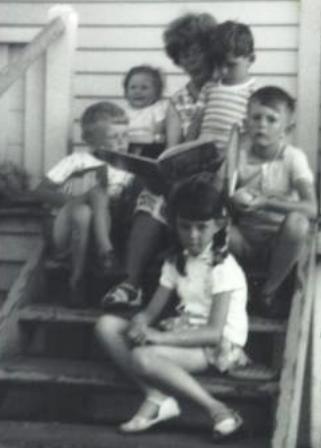
 When my eldest son was born he was given, by his godparents, a set of the Winnie-the-Pooh books I thought it at the time a very sensible present, a lot more sensible than the steady flow of booties and bonnets. It took him some time to reach the age of appreciation of course but in the fullness of time they became beloved stories by him and his sisters and brothers.
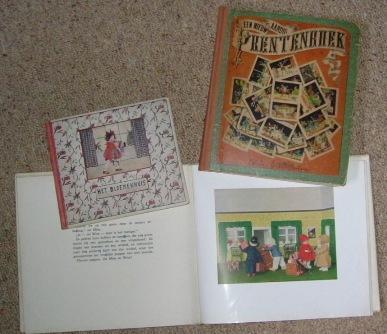 But before that happened, we all enjoyed the age of picture books, owned and borrowed from the library, in large quantities. They became the stepping stones to literacy: words got anchored down by the pictures and very often became part of the child.
I have vivid recollections of picture books from my own far-away childhood. They belonged to a little cousin, an only child, whose parents bought her all kinds of lovely books. She was the same age as I was but she died suddenly a few days after her fourth birthday. Her books stayed in the bookcase and when I and my brothers visited afterwards we were always allowed to enjoy them. Our uncle read to us out of them and much later I inherited some. They are a precious part of my large collection of children's books.
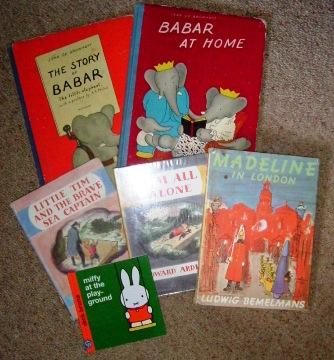 For my own children, many of 'The little Golden Books' were read and enjoyed, but the more substantial had eternal life like the 'Babar' stories, the 'Madeline' series, the books about Little Tim and many others, which also became popular with the next generation.
 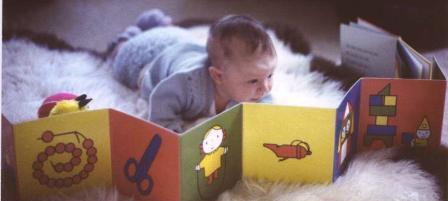 These were added to by new greats, like Dick Bruna's little books, Thomas the Tank Engine and even Noddy (but mainly for the pictures of toy figures and even Gollies).
Now those grandchildren have grown up and we - the Mad Hatter duo - are left with surveying the whole fascinating scene of picture books, starting in the early 1800s. There were first chapbooks (1 penny plain, tuppenny coloured): 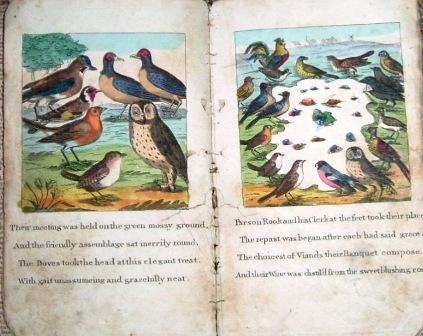 simple short texts, mainly religious and educational. Around 1820 they had blossomed into series of delightful stories and rhymes with accomplished full page pictures, very often hand coloured.
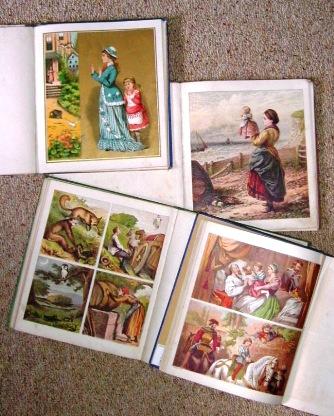 A decade later publishers and printers took advantage of the newly invented process of colour printing and children's books were the first to benefit. The early examples are timid affairs, but from the 1850s, many stunning books appeared, many with illustrations printed by a German firm J.M.Kronheim. The colours are vibrant and, to our eyes, reflect a darker age. I have quite a number of examples in my collection, and I wonder sometimes how children reacted to them. Towards the end of the 19th century artists like Kate Greenaway, Randolph Caldecott & Walter Crane prepared the way for countless other artists to delight small children and their parents.
We are all acquainted with the 1920s and 30s pictures by Cecily M. Barker (the Flower Fairies), Susan Pearse (the Ameliarane series) and Anne Anderson. They, and many others from that period, are eagerly collected, partly out of nostalgia, but also because of their obvious visual appeal.
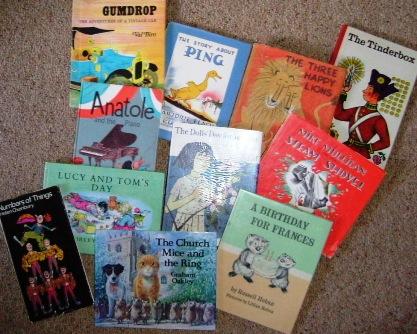 We all know the lovely books by Shirley Hughes, Helen Oxenbury, John Burningham and the creations of Dr Seuss and Bill Peet. It is a long, long list and it can be added to every year. We don't even have to move overseas to please the little ones. We have Lynley Dodd, Gavin Bishop, Ronda and David Armitage of Lighthouse Keeper fame, Dorothy Butler, Betty Gilderdale, Margaret Mahy ...
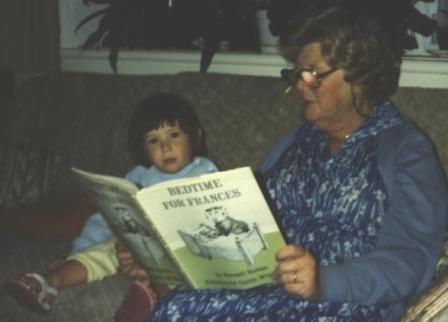 Every bookshop has shelves full of enticing picture books and so has 'Mad Hatter', at the latest count close to 2000 from early ones to the present time.
Jacoba Filbry
June 2006